Balloon Flight Height and Altitude: How High Do Cappadocia Balloons Go?
By Anastasia Petrova, Cappadocia Travel & Hot Air Balloon Experience Writer
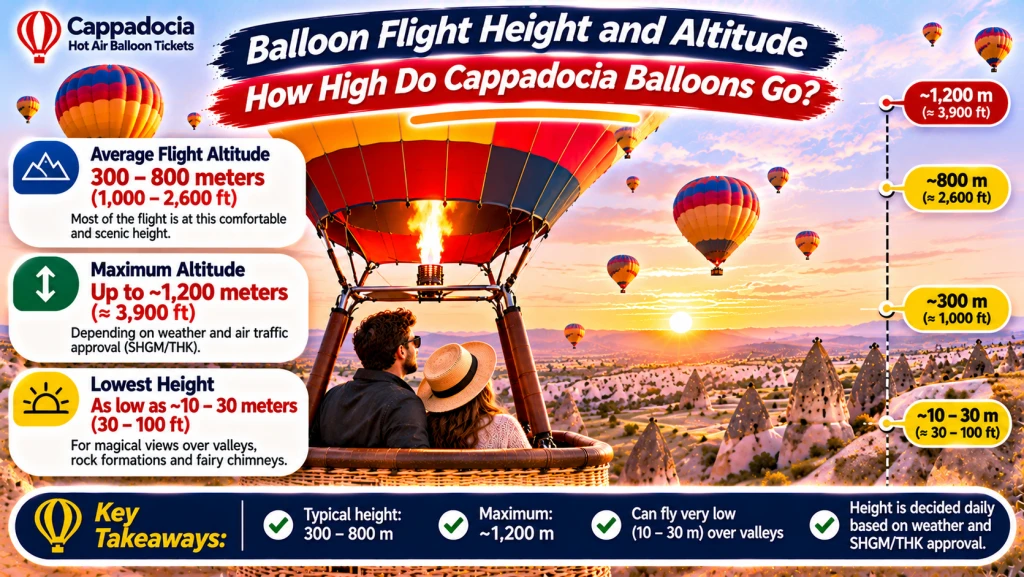
Cappadocia balloons usually cruise at roughly 300 to 600 metres above the ground and reach up to around 900 metres (about 3,000 feet) at the highest point of a typical flight, while also dropping low enough to glide a few metres above the rocks in the valleys. The exact height changes throughout the hour and is chosen by the pilot within the limits of the civil aviation authority.
"How high will we go?" is the question I hear most often at the launch field, usually from someone who is excited and a little nervous at the same time. It is a fair question, and the answer is more interesting than a single number. A balloon flight over Cappadocia is not a straight climb to a fixed height followed by a descent. It is a slow, changing journey: low between the fairy chimneys, high above the valleys for the wide view, then low again as the pilot looks for a landing spot. This guide explains the typical heights at each stage, who decides them, what the view and the temperature are like up there, and why most people who fear heights end up enjoying it. If you simply want the classic sunrise experience, the standard Göreme balloon flight covers every one of these stages in about an hour.
Balloon height in Cappadocia: quick facts
Here are the figures people ask about most, rounded the way pilots usually describe them.
QuestionShort answerTypical cruising height | Roughly 300–600 metres above the ground (about 1,000–2,000 feet) |
Highest point on most flights | Up to around 900 metres above the ground (about 3,000 feet) |
Lowest passes | A few metres above the rocks and treetops in the valleys |
Who decides the height? | The pilot, within the limits set by the civil aviation authority |
Time in the air | About an hour on a standard flight, about 90 minutes on the extended flight |
Does basket size change the height? | No, small and large baskets reach similar heights |
Does it feel like vertigo? | Rarely, because the balloon moves gently and there is no edge to look down from |
Is it cold up high? | Not usually colder than the launch field, and the burner adds warmth |
In this guide
- How high do Cappadocia balloons fly?
- How does the height change during a flight?
- What is the highest point of a balloon flight?
- How low do balloons fly over the valleys?
- Who decides how high the balloon goes?
- Is it scary to be that high in a balloon?
- Is it colder higher up?
- Do bigger or smaller baskets fly higher?
- Does a longer flight mean a higher flight?
- Which height is best for photos?
- How far can you see from a balloon?
- Does flying higher make a balloon less safe?
- Frequently asked questions

How high do Cappadocia balloons fly?
Cappadocia balloons typically fly between a few metres and around 900 metres above the ground, spending most of the flight at roughly 300 to 600 metres. That range is what makes the flight special: you get both the close-up views of the rock formations and the wide panorama of the valleys in a single hour.
It helps to think of height above the ground rather than above sea level. The Cappadocian plateau is already high, so the numbers you may see elsewhere for "altitude" can be confusing. What matters to you in the basket is how far below you the valleys are, and that changes constantly. In the first minutes after take-off the balloon often stays low, then rises gently as the sun comes up, sometimes climbing to its highest point just as the light spreads across the landscape.
No two flights follow exactly the same profile. On some mornings the wind at lower levels carries the balloon along the valleys, and the pilot stays low. On others, the useful wind is higher up, and the balloon spends longer above the rim. Either way, you will see both sides of Cappadocia: the intimate and the panoramic.
How does the height change during a flight?
The height of a Cappadocia balloon changes throughout the flight, rising from the launch field, gliding low over the valleys, climbing for the panorama and descending gently to land. Here is how a typical hour unfolds, with the heights pilots usually work with.
Stage of the flightTypical height above the groundWhat you noticeTake-off | From ground level, rising slowly | A surprisingly soft lift, more like floating than flying |
Valley passes | A few metres above the rocks | Cave windows, dovecotes and orchards almost within reach |
Cruising | Roughly 300–600 metres | The valleys open up and dozens of balloons surround you |
Highest point | Up to around 900 metres | The widest view of the region, with balloons below you |
Approach to landing | Descending gradually | The pilot reads the wind and looks for open ground |
Landing | Back to ground level | A gentle touchdown, usually on a field or a track |
The changes are slow and smooth. You will rarely feel the balloon climb or descend; you will notice it instead when the view changes, when the balloons that were above you are suddenly below, or when a fairy chimney seems close enough to touch.
What is the highest point of a balloon flight?

The highest point of most Cappadocia balloon flights is up to around 900 metres above the ground, which is about 3,000 feet. Not every flight goes that high, because the pilot chooses the height for the wind and the view, not to reach a target.
At the top of the flight, the landscape changes character. The valleys that seemed enormous from the ground become a pattern of ridges, folds and pale rock, and you can see how Göreme, Uçhisar and the surrounding villages fit together. The balloons below you look like scattered lanterns. Many passengers find this the most peaceful part of the hour: the burner is quieter, the basket is still and the sky feels very wide.
If the highest point is what you are most looking forward to, the extended flight gives the pilot more time to combine low passes with a long stretch at height. The 90-minute extended balloon flight is the option for travellers who want more of both.
How low do balloons fly over the valleys?

Balloons in Cappadocia can fly just a few metres above the rocks and treetops when they pass through the valleys, which is one of the most memorable parts of the flight. These low passes are deliberate and carefully controlled by the pilot.
Down in the valleys you see details that disappear from higher up: rock-cut windows and doorways, pigeon houses carved into the cliffs, small vineyards and apricot trees, and the soft colours of the volcanic tuff. The balloon moves slowly enough that you have time to look properly. On calm mornings the pilot may bring the basket along the edge of a ridge or between the cones of the fairy chimneys before climbing again, and the contrast between the close-up and the panorama is what most people remember. The guide on which balloon flight is best for photographers explains how to use these low passes for pictures.
Who decides how high the balloon goes?
The pilot decides how high the balloon goes at every moment, working within the limits set by Türkiye's civil aviation authority. Height is the pilot's main way of steering, because a balloon has no engine to push it sideways.
Winds blow in different directions and at different speeds at different heights. By climbing or descending, the pilot finds the layer of air that carries the balloon where it should go: along a valley, over a viewpoint, or towards an open landing area. That is why the profile of a flight depends on the morning. The authority decides whether the morning is suitable for flying at all and sets the rules for the airspace, and within those rules the pilot shapes the flight. You do not need to ask for a particular height; a good pilot will show you both the low valleys and the high views whenever the wind allows.
Is it scary to be that high in a balloon?

Most people find a balloon flight much less scary than they expected, even if they are afraid of heights, because the balloon moves gently and there is no sense of falling or of standing on an edge. Many nervous passengers say it felt calmer than a tall building or a glass lift.
The reason is partly physical and partly psychological. The balloon moves with the wind, so there is almost no breeze in the basket and no rushing air to remind you of the height. The basket walls come up to around chest height, so you are standing inside something solid rather than at an open edge. And because the climb is slow, your eyes and mind adjust as you go. Look at the horizon and the other balloons rather than straight down for the first minutes, and the feeling usually passes. If it is your first flight, the guide on which balloon flight is best for first-timers explains why a calm, smaller basket can help, and the small-basket comfort flight gives you space at the rail without the crowd.
Is it colder higher up?
It is usually not noticeably colder at the top of a balloon flight than at the launch field, and the burner above your head adds warmth every time it fires. The coldest part of the morning is often the wait on the ground before sunrise.
In Cappadocia, cold air tends to settle in the valleys during the night, so the air a little higher up can be similar or even milder at dawn. Once the sun rises, you also feel its warmth directly. Dress in warm layers anyway, because the launch field can be cold in every season and close to freezing in winter, and wear a hat in the colder months. The basket is the warmest place of the morning more often than people expect.
Do bigger or smaller baskets fly higher?
No, bigger and smaller baskets do not fly at different heights; a private basket and a standard basket follow the same kind of flight profile. The size of the basket changes how many people share the rail, not how high the balloon goes.
FlightPeople in the basketTime in the airEffect on heightStandard Göreme | 20–28 | About an hour | Same range of low passes and high views |
Small basket (comfort) | 12–16 | About an hour | Same heights, more space to enjoy them |
Deluxe premium | 8–16 | About 75 minutes | Same heights, a little more time at each |
Extended flight | 12–20 | About 90 minutes | Same heights, the most time to combine them |
Private basket | 2–4 | About an hour | Same heights, with the whole rail to yourselves |
If height is your priority, choose by flight time rather than basket size. The full range of options is explained in the guide to Cappadocia balloon flight types.
Does a longer flight mean a higher flight?
A longer flight does not mean a higher maximum height, but it gives the pilot more time to combine low valley passes with long stretches at height. That extra time is what makes the extended flight feel fuller.
On a standard flight of about an hour, the pilot has to balance the low passes, the panorama and the landing within a fixed time. On a flight of about 90 minutes, there is room for more of everything: a longer climb, more time at the top as the light changes and a more relaxed descent. The guide comparing 60-minute and 90-minute balloon flights explains whether the extra half hour is worth it for you.
Which height is best for photos?
The best photos usually come from the middle heights, roughly 300 to 600 metres, where you can fit the fairy chimneys, the valleys and dozens of balloons into the same frame. The low passes are best for details, and the highest point for wide landscape shots.
My advice is to use each stage for a different kind of picture. During the low passes, photograph textures, cave windows and other balloons close by. At cruising height, frame the classic view of balloons above the valleys in the warm early light. At the top, switch to wide shots and panoramas. And keep your phone or camera on a strap: you will be moving around the basket as the balloon turns, and the best moments come quickly.
How far can you see from a balloon?
On a clear morning you can see across much of central Cappadocia from the highest point of a balloon flight, from the valleys around Göreme to the distant volcanic peaks on the horizon. The visibility depends on the season and the haze, and the clearest views often come in autumn and winter.
From the top you can usually pick out the castle rock of Uçhisar, the town of Göreme and the long valleys running towards Avanos and Ürgüp. On the clearest mornings, the snowy summit of Mount Erciyes appears on the horizon. Closer in, the landscape you are floating over is part of the Göreme National Park and the Rock Sites of Cappadocia, listed by UNESCO as a World Heritage Site, and seeing it from above makes it clear why: the valleys, churches and villages form one remarkable whole.
Does flying higher make a balloon less safe?
Flying higher does not make a balloon less safe; safety depends on the weather, the pilot's skill and the aviation rules, not on the height itself. Balloons only fly on mornings that the civil aviation authority has approved, and pilots stay within the limits it sets.
Every licensed operator follows the same rules, every pilot is licensed and every basket carries passenger insurance. A weather cancellation, which happens when wind or visibility is not suitable, is moved to a new date or refunded in full. If you are nervous, focus on what actually matters: choose a licensed flight, listen to the safety briefing, take the landing position when the pilot asks, and enjoy the view. Height is part of the beauty of the flight, not a risk to worry about.
Local insight
Passengers who are nervous about heights often spend the first ten minutes holding the rail and looking only at the horizon. By the time the balloon reaches its highest point, most of them are leaning over to point out the other balloons below. The change comes from the calm: there is no wind in the basket, no sudden movement and no sense of falling, only a slow, quiet rise into the light.
From the valley floor to the panorama

The standard Göreme balloon flight: about an hour at sunrise, from low passes between the fairy chimneys to the wide view above the valleys, with hotel pickup, light breakfast, landing celebration, flight certificate, passenger insurance and taxes included. The current starting prices are shown on the flight page.
Frequently Asked Questions
How high do balloons fly in Cappadocia?
Most flights cruise at roughly 300 to 600 metres above the ground and reach up to around 900 metres, about 3,000 feet, at their highest point, with low passes just a few metres above the rocks.
What is the maximum height of a Cappadocia balloon flight?
On most flights the highest point is up to around 900 metres above the ground. The exact height depends on the wind and is chosen by the pilot within the limits of the civil aviation authority.
How low do the balloons go?
During valley passes, balloons can glide just a few metres above the rocks, close enough to see cave windows and orchards in detail.
How high is a balloon flight in feet?
Cruising is usually around 1,000 to 2,000 feet above the ground, and the highest point of most flights is up to around 3,000 feet.
Can I fly in a balloon if I am afraid of heights?
Many people with a fear of heights fly and enjoy it. The movement is gentle, there is no wind in the basket and the walls come up high, so it rarely feels like standing on an edge.
Is it cold at the top of a balloon flight?
Usually not colder than the launch field, and the burner adds warmth. The coldest moment is often the wait on the ground before sunrise, so wear warm layers.
Do private balloons fly higher than shared ones?
No. Private and shared baskets follow the same kind of flight profile; basket size changes the space, not the height.
Does the extended flight go higher?
It does not go higher, but its extra time lets the pilot spend longer at height and combine more low passes with the panorama.
Who decides how high the balloon flies?
The pilot, who changes height to find the right wind direction, within the rules set by Türkiye's civil aviation authority.
Can you see Mount Erciyes from a balloon?
On very clear mornings, yes: its snowy summit can appear on the horizon from the higher part of the flight. Visibility depends on the season and the haze.
See Cappadocia from every height
The beauty of a balloon flight over Cappadocia is that you do not have to choose between the close-up and the panorama: in one hour you get both. Book the first morning of your stay, dress warmly and let the pilot take you from the valley floor to the top of the sky.